
SIGNUX CLA01
Water Chlorine residual concentration
Integrated residual chlorine transmitter for treated water, with a three-electrode cell and RS485 Modbus RTU output. Three ranges up to 20 mg/L, with standard or gold electrode.
The SX-CLA01 measures residual chlorine concentration in water. Cell and electronics share one body: the integrated design outputs the RS485 signal directly, which is the reason it is free of signal interference.
It is a non-membrane, constant-voltage type with a three-electrode system. There is no membrane and no reagent to replace: the three-electrode system gives high measurement accuracy, long working life and no need for frequent calibration. It resolves 0.01 mg/L, to within ±5 % of full scale, with ±0.05 mg/L of repeatability, and responds in under 30 seconds.
Measuring ranges are fixed when ordering — 0 to 2, 0 to 10 or 0 to 20 mg/L — with a standard or a gold electrode. The electrode has a service life of about one year depending on the water and usage conditions. Keep the platinum wire clean and bright, because dirt and mineral deposits on it reduce sensitivity and may stop it measuring properly.
- Measures
- Chlorine residual concentration
- Output
- Protection
- IP68
- Operating
- 0 to +50 °C
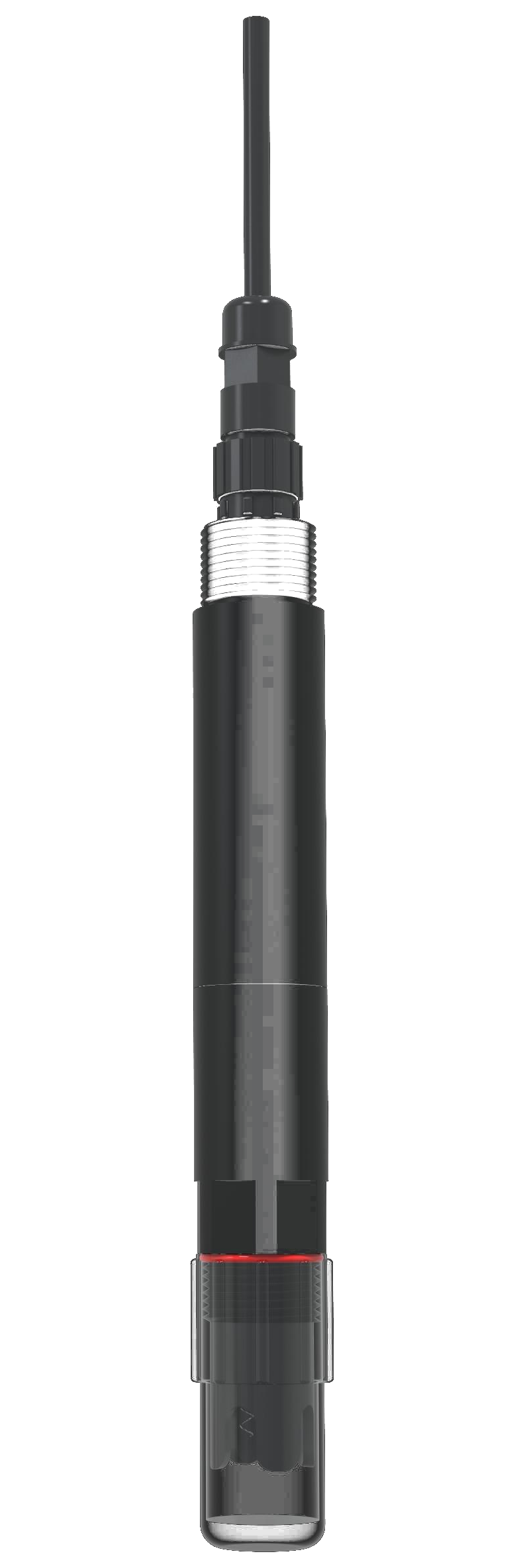
What sets it apart
Three electrodes
They let it measure down to 0.01 mg/L and settle in under 30 seconds.
Three ranges
2, 10 or 20 mg/L, each with a standard or a gold electrode. Chosen when ordering.
Installation
NPT 3/4 in at both ends, IP68, 6 bar, and the same four wires.
Configurations
| Measurement range | Electrode type | Part number |
|---|---|---|
| 0-2 mg/L | Standard | SX-CLA01-2 |
| 0-2 mg/L | Gold | SX-CLA01-2A |
| 0-10 mg/L | Standard | SX-CLA01-10 |
| 0-10 mg/L | Gold | SX-CLA01-10A |
| 0-20 mg/L | Standard | SX-CLA01-20 |
| 0-20 mg/L | Gold | SX-CLA01-20A |
Specifications
General
- Measured parameters
- Chlorine residual concentration
- Output
- RS485Modbus RTU
- Device Installation
- NPT 3/4 inAt both ends
- Measuring principle
- Three-electrode
Chlorine residual concentration
- Range
- 0 to 2 mg/LChosen when ordering
- Range
- 0 to 10 mg/L
- Range
- 0 to 20 mg/L
- Resolution
- 0.01 mg/L
- Accuracy
- ±5 % FS
- Repeatability
- ±0.05 mg/L
- Response time
- < 30 s
Operating conditions
- Water temperature
- 0 to +50 °C
- Water pH
- 4 to 9 pHOutside this range the reading is not valid
- Flow rate
- 30 to 60 L/hThe water must be moving past the cell
Output and power
- Output interface
- RS485Modbus RTU, baud rate configurable from 1200 to 115200 baud
- Default communication
- 4800 baud · address 18 data bits, no parity, 1 stop bit
- Power supply
- 7-30 V DC
- Power consumption
- 0.19 W
- Configuration
- Over RS485Address and baud rate
Construction
- Protection rating
- IP68
- Maximum pressure
- 0.6 MPa
- Cable length
- 5 mOther lengths on request
- Electrode life
- 1 yearA consumable: it is replaced as it ages
- Overall length
- 266 mmBody 212 mm
- Diameter
- 30 mm
Manual
1Introduction
The SX-CLA01 measures free residual chlorine in treated water. Cell and electronics share one body, so the probe connects directly to an RS485 bus with Modbus RTU protocol.
The cell is amperometric with three electrodes and a constant working voltage, and needs neither a membrane nor reagents. It is meant for circulating-water dosing control, swimming pool chlorination, drinking water treatment and distribution, and hospital effluent.
- •Free chlorine from 0 to 2, 0 to 10 or 0 to 20 mg/L, resolution 0.01 mg/L
- •Three-electrode constant-voltage cell: no membrane and no reagents to replace
- •Integrated design: the RS485 signal leaves the probe itself
- •3/4 in thread at top and bottom, easy to install
- •IP68 protection rating
- •RS485 interface with Modbus RTU protocol
- •Modbus address and baud rate configurable
- •Wide supply range, 7 to 30 V DC
| Power supply | 7-30 V DC |
| Power consumption | 0.19 W |
| Communication interface | RS485, Modbus RTU 4800 baud by default |
| Measuring range | 0-2, 0-10 or 0-20 mg/L, resolution 0.01 mg/L |
| Accuracy | ±5 % FS |
| Repeatability | ±0.05 mg/L |
| Response time | Under 30 s |
| Water temperature | 0 to +50 °C |
| Water pH | 4 to 9 |
| Flow rate | 30 to 60 L/h in a flow-through cell |
| Pressure resistance | 0.6 MPa |
| Protection rating | IP68 |
| Cable length | 5 m by default (10, 15 and 20 m on request) |
| Electrode life | About one year |
2Wiring
The probe is supplied with a four-core cable with bare ends.
| Function | Wire colour | Description |
|---|---|---|
| Power supply | Brown | Power supply positive (7-30 V DC) |
| Power supply | Black | Power supply negative (GND) |
| Communication | Yellow | RS485 A |
| Communication | Blue | RS485 B |
Do not take the colours for granted from memory: not every water probe follows the same convention.
3Dimensions, model and what is in the box
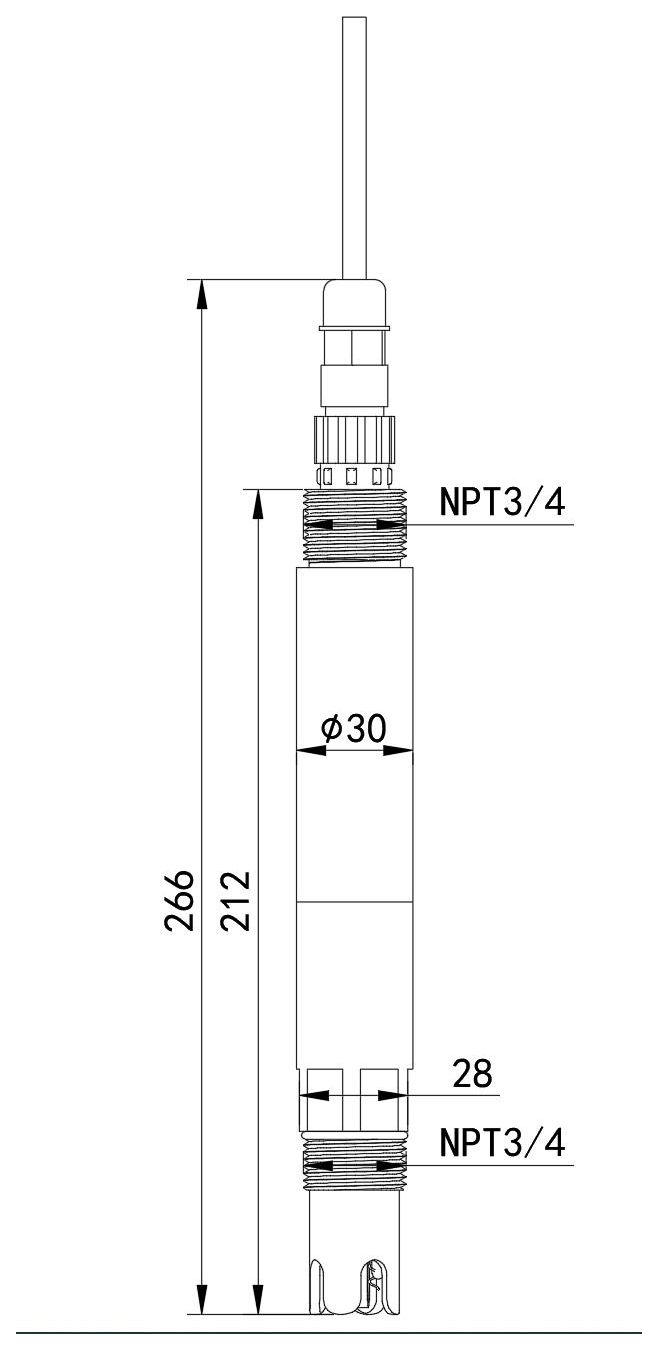
The model code states the range and the electrode. Both are fixed when ordering and cannot be changed afterwards.
| Code | Meaning |
|---|---|
| SX-CLA01 | Residual chlorine transmitter with RS485 Modbus RTU output |
| 2 · 10 · 20 | The range: 0-2, 0-10 or 0-20 mg/L |
| A | Gold electrode. Without the A, standard electrode |
- •One integrated residual chlorine transmitter
- •5 m cable (or the length ordered)
4Safety, care and installation
4.1Installation
- •Submerged installation: run the cable through a rigid waterproof bracket and screw the bracket onto the 3/4 in thread on top of the probe, sealing the thread with PTFE tape.
- •Pipe installation: screw the probe into the pipe through the 3/4 in thread at its lower end.
Two conditions have to be met for the reading to mean anything. The water must be moving past the cell, between 30 and 60 litres an hour in a flow-through fitting: in still water the probe reads its own boundary layer and drifts. And the water must sit between pH 4 and 9, because the share of free chlorine present as hypochlorous acid — the part that disinfects — depends on it. Out of the water the probe reads 0.00 mg/L and stays there; that is normal, not a fault.
4.2Care and maintenance
- •The equipment needs no routine maintenance. If it fails, do not open it: contact SIGNUX.
- •After use, rinse the head with clean water and fit the protective cover.
- •The platinum wire must stay clean and bright. Dirt or mineral deposits on it lower the sensitivity, and the probe may stop measuring properly.
- •Before measuring, make sure the cell is wet and free of bubbles.
- •The electrode lasts about a year. It is a consumable: replace it when it ages.
4.2.1Cleaning the platinum wire
If the platinum wire becomes rough or is covered by deposits, clean it according to what has fouled it.
| Contamination | How to clean it |
|---|---|
| Inorganic deposits | Soak the head in 0.1 mol/L dilute hydrochloric acid for 15 minutes, wipe the platinum wire gently with a cotton swab and rinse with tap water |
| Organic matter or oil | Soak the head in tap water with a little detergent, wipe the sensing surface and the platinum wire gently with a cotton swab, and rinse with tap water |
| Oxide film on the wire | Polish the sensing surface lightly with toothpaste or 1000 grit paper, then rinse with tap water |
Take care when polishing: the platinum ring is bonded to the glass, and forcing it breaks the cell.
5Adjusting the reading
The probe carries two adjustment values: a coefficient A, which multiplies the reading, and a deviation B, which is added to it. From the factory A is 1.0 and B is 0.0.
Both are 32-bit floating-point values, each held in a pair of registers — A in 0x1010 and 0x1011, B in 0x1012 and 0x1013 — and written with function code 16. To move a reading of 7.90 mg/L up to 8.00, the difference of 0.10 is encoded as a float (0x3DCCCCCD) and written to the B pair.
The SIGNUX configuration tool cannot write these two values yet: it does not handle floating-point registers. Until it does, the adjustment has to be made with a Modbus master that can write a float across two registers.
6Modbus RS485 protocol
6.1Communication parameters
| Encoding | 8-bit binary |
| Data bits | 8 |
| Parity | None |
| Stop bits | 1 |
| Error check | CRC (cyclic redundancy check) |
| Baud rate | 4800 bit/s by default (1200 to 115200 configurable) |
| Device address | 1 (0x01) by default |
6.2Frame format
| Silence before the frame | ≥ 4 byte times |
| Address code | 1 byte: the address of the transmitter, unique on the bus (factory default 0x01) |
| Function code | 1 byte: the operation requested by the master |
| Data area | N bytes: register addresses, counts and values |
| Error check | 2 bytes: CRC |
| Silence after the frame | ≥ 4 byte times |
All 16-bit values are sent high byte first. The two floating-point pairs are big-endian: high word in the lower address.
6.3Modbus registers
| Register address | Function codes (DEC) | Description |
|---|---|---|
| 0x0000 | 3 / 4 | Free chlorine concentration. UINT16, 100 times the value |
| 0x1010 / 0x1011 | 3 / 4 / 16 | Coefficient A, the gain applied to the reading. 32-bit float, 1.0 from the factory |
| 0x1012 / 0x1013 | 3 / 4 / 16 | Deviation B, added to the reading. 32-bit float, 0.0 from the factory |
| 0x07D0 | 3 / 4 / 6 / 16 | Device address: 1-254 (UINT16, factory default 1) |
| 0x07D1 | 3 / 4 / 6 / 16 | Baud rate: 0 = 2400, 1 = 4800, 2 = 9600, 3 = 19200, 4 = 38400, 5 = 57600, 6 = 115200, 7 = 1200 (factory default 1 = 4800) |
- •UINT16: 16-bit unsigned integer
- •Float: 32-bit IEEE 754, high word first
6.4Communication examples
6.4.1Example 1: read the free chlorine
| Slave address | 1 byte | 0x01 |
| Function code | 1 byte | 0x03 |
| Start register | 2 bytes | 0x0000 |
| Number of registers | 2 bytes | 0x0001 |
| CRC | 2 bytes | 0x84 0x0A |
| Slave address | 1 byte | 0x01 |
| Function code | 1 byte | 0x03 |
| Number of data bytes | 1 byte | 0x02 |
| Concentration | 2 bytes | 0x0316 |
| CRC | 2 bytes | 0x39 0x7A |
0x0316 is 790 in decimal, so the concentration is 790 / 100 = 7.90 mg/L.
6.4.2Example 2: correct the reading with the deviation
The probe reads 7.90 mg/L and the reading should be 8.00. The difference is 0.10, which as a 32-bit float is 0x3DCCCCCD. It is written to the B pair, 0x1012 and 0x1013, with function code 16 and two registers in one frame: the high word 0x3DCC first, the low word 0xCCCD second.
| Slave address | 1 byte | 0x01 |
| Function code | 1 byte | 0x10 |
| Start register | 2 bytes | 0x1012 |
| Number of registers | 2 bytes | 0x0002 |
| Number of bytes | 1 byte | 0x04 |
| 0x1012 · high word | 2 bytes | 0x3DCC |
| 0x1013 · low word | 2 bytes | 0xCCCD |
| CRC | 2 bytes | 0xE7 0xBC |
| Slave address | 1 byte | 0x01 |
| Function code | 1 byte | 0x10 |
| Start register | 2 bytes | 0x1012 |
| Number of registers | 2 bytes | 0x0002 |
| CRC | 2 bytes | 0xE5 0x0D |
Gallery
Related products


Documentation
Does it fit your case?
Tell us where the SX-CLA01 is going and what you need to integrate it with. We’ll tell you whether it’s the right device — and if not, which one is.