
SIGNUX PHA01
Water pH and temperature
Integrated pH transmitter for water and aqueous solutions, with automatic or manual temperature compensation and RS485 Modbus RTU output.
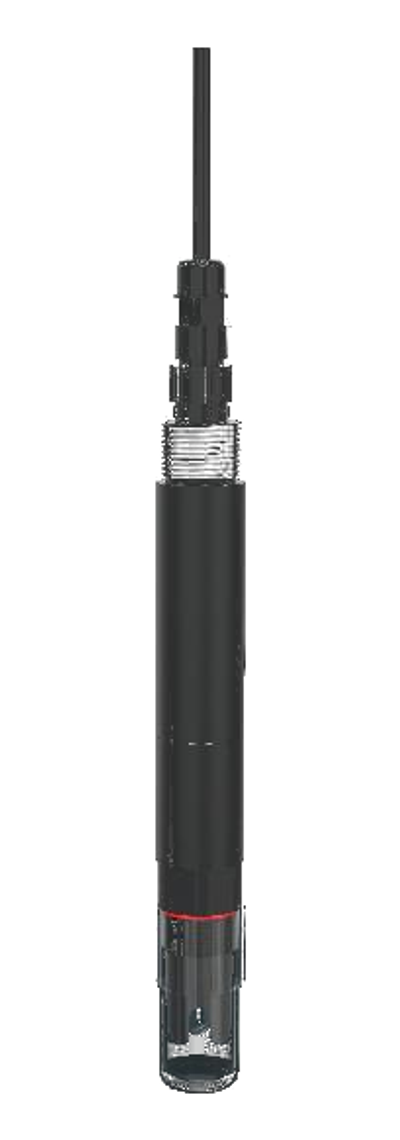
The SX-PHA01 measures pH and temperature in the same body. Electrode, reference and electronics are one piece, so there is no separate transmitter and no junction box: four wires go straight onto an RS485 bus speaking Modbus RTU.
The pH reading arrives temperature-compensated. The probe compensates automatically from its own temperature sensor, or against a fixed temperature if manual compensation is switched on, which is what you want when the process sits at a known temperature and the reading should not chase it. Both the switch and the fixed value are registers, so it is decided over the bus.
The reference uses a double salt bridge, which is what lets it keep working in dirty water — sewage, aquaculture, process effluent — where a single junction clogs and the reading drifts. The electrode is a consumable: it ages, loses sensitivity and is replaced, and it must never be stored dry.
- Measures
- pH · Temperature
- Output
- Protection
- IP68
- Operating
- 0 to +60 °C
What sets it apart
Compensates either way
Automatically, from its own temperature reading, or against a fixed temperature written over the bus. Both are registers: no jumper, nothing to open.
Double salt bridge
The reference is built to last in dirty water — sewage, aquaculture, process effluent — where a single junction clogs and the reading drifts away.
Calibrated over the bus, two points
No buttons and no screwdriver: two standard buffers written to a register pair. For general use, 4.01 and 9.18.
One-piece housing
NPT 3/4 thread at both ends and the electronics inside the same body: it mounts submerged from a rigid tube or through the side of a pipe, with no separate enclosure and no wiring in between.
Configurations
| Connector / output | Part number |
|---|---|
| M10 connector | SX-PHA01-M10 |
| Pigtail | SX-PHA01-PT |
Specifications
General
- Measured parameters
- pH · Temperature
- Output
- RS485Modbus RTU
- Process connection
- NPT 3/4 inAt both ends
- Reference
- Double salt bridge
pH
- Range
- 0 to 14.00 pH
- Resolution
- 0.01 pH
- Accuracy
- ±0.15 pH
- Repeatability
- ±0.02 pH
- Temperature compensation
- Automatic or manualManual compensation uses a fixed temperature, 25 °C by default
Temperature
- Range
- 0 to +60 °C
- Resolution
- 0.1 °C
- Accuracy
- ±0.5 °C
Output and power
- Output interface
- RS485Modbus RTU, baud rate configurable from 1200 to 115200 baud
- Default communication
- 4800 baud · address 18 data bits, no parity, 1 stop bit
- Power supply
- 7-30 V DC
- Power consumption
- 0.3 W
- Configuration
- Over RS485Address, baud rate, offsets, compensation and calibration
Construction
- Protection rating
- IP68
- Operating temperature
- 0 to +60 °C
- Maximum pressure
- 6 bar0.6 MPa
- Cable length
- 5 mOther lengths on request
- Electrode life
- 1 yearA consumable: it is replaced as it ages
- Overall length
- 266 mmBody 212 mm
- Diameter
- 30 mm
Manual
1Introduction
The SX-PHA01 is an integrated pH transmitter for aqueous solutions. Electrode, reference, temperature sensor and electronics share one body, so the probe connects directly to an RS485 bus with Modbus RTU protocol and reports pH and temperature.
The pH value arrives temperature-compensated: automatically, from the probe own temperature reading, or against a fixed temperature when manual compensation is switched on. The reference uses a double salt bridge, which resists fouling better than a single junction in sewage, aquaculture and process water.
- •pH from 0 to 14.00, resolution 0.01 pH
- •Temperature from 0 to +60 °C, resolution 0.1 °C
- •One-piece design, light and simple to install
- •Double salt bridge reference, with stronger resistance to fouling
- •IP68 protection rating
- •Automatic or manual temperature compensation, switchable over the bus
- •RS485 interface with Modbus RTU protocol
- •Modbus address and baud rate configurable
- •Wide supply range, 7 to 30 V DC
| Power supply | 7-30 V DC |
| Power consumption | 0.3 W |
| Communication interface | RS485, Modbus RTU 4800 baud by default (1200, 2400, 4800, 9600, 19200, 38400, 57600 and 115200 selectable) |
| pH range | 0 to 14.00 pH, resolution 0.01 pH |
| pH accuracy | ±0.15 pH |
| Repeatability | ±0.02 pH |
| Temperature range | 0 to +60 °C, resolution 0.1 °C |
| Temperature accuracy | ±0.5 °C |
| Temperature compensation | Automatic or manual; the manual value is 25 °C by default |
| Operating conditions | Ambient 0 to +60 °C |
| Protection rating | IP68 |
| Pressure resistance | 0.6 MPa |
| Cable length | 5 m by default (other lengths on request) |
| Electrode life | About one year |
2Wiring
The probe is supplied with a four-core cable with bare ends.
| Function | Wire colour | Description |
|---|---|---|
| Power supply | Brown | Power supply positive (7-30 V DC) |
| Power supply | Black | Power supply negative (GND) |
| Communication | Yellow | RS485 A |
| Communication | Blue | RS485 B |
Do not take the colours for granted from memory: not every water probe follows the same convention.
3Dimensions, model and what is in the box
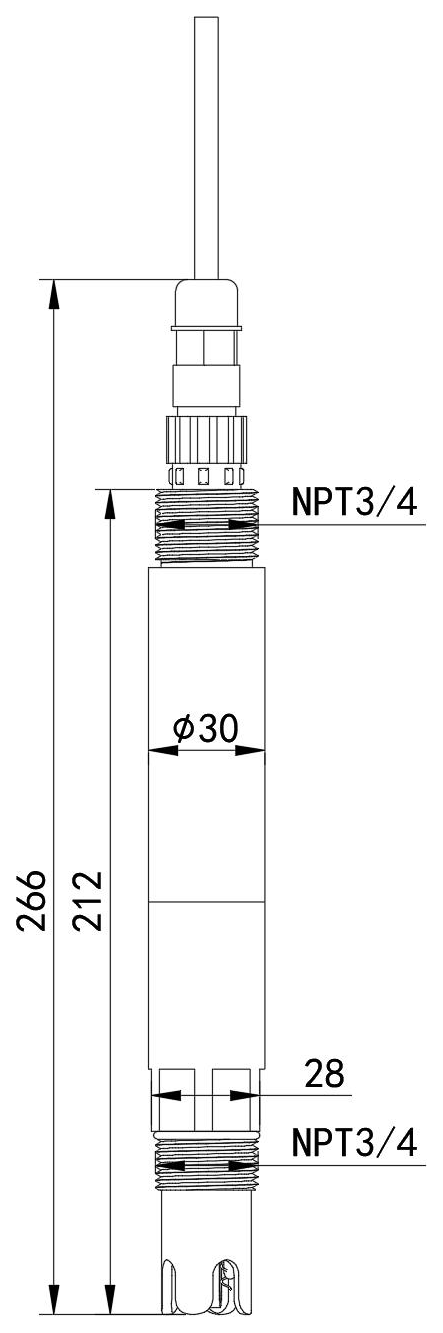
The model code says how the cable ends. It is chosen when ordering and does not change afterwards.
| Code | Meaning |
|---|---|
| SX-PHA01 | pH transmitter with RS485 Modbus RTU output |
| M10 · PT | With an M10 connector, or with bare wires |
- •One integrated pH transmitter
- •5 m cable (or the length ordered)
4Safety, care and installation
4.1Installation
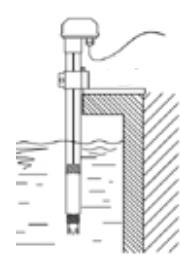
- •Submerged installation: run the cable through a rigid waterproof pipe and screw the pipe onto the 3/4 in thread on top of the probe, sealing the thread with PTFE tape. The top of the probe and the cable must stay dry.
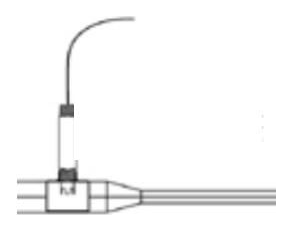
- •Pipe installation: screw the probe into the pipe through its 3/4 in thread.
- •Before the first measurement, unscrew the protective bottle, pull the electrode out and rinse it with pure water.
- •Shake the air bubbles off the glass bulb before measuring: a bubble against the bulb changes the reading.
- •Stir the solution, then let the probe settle before reading.
4.2Care and maintenance
- •The equipment needs no routine maintenance. If it fails, do not open it: contact SIGNUX.
- •The electrode must never be stored dry. The protective bottle holds a soaking solution that keeps the glass bulb and the liquid junction active; keep the tip in it whenever the probe is not in service.
- •Soaking solution: dissolve one sachet of pH 4.00 buffer in 250 ml of pure water and add 56 g of analytical grade potassium chloride, warming and stirring until it dissolves. A 3.3 M potassium chloride solution also works: 25 g of analytical grade potassium chloride in 100 ml of pure water.
- •The glass bulb must not touch anything hard. Any knock or scrape destroys the electrode.
- •Rinse the electrode with deionised water before and after every measurement.
- •An electrode that has been in service a long time goes passive: the slope drops, the response slows down and the reading stops being accurate. Soak the bulb in 0.1 M dilute hydrochloric acid for 24 hours, then in 3.3 M potassium chloride for another 24 hours.
- •The electrode lasts about a year. It is a consumable: replace it when it ages.
- •Calibrate before each use, and at least every three months in continuous service. Dirty or chemically loaded water calls for calibrating more often.
4.2.1Cleaning a fouled electrode
Fouling of the glass bulb or a blocked liquid junction also makes the electrode go passive. The cleaner depends on what has fouled it.
| Contaminant | Cleaner |
|---|---|
| Inorganic metal oxides | Dilute acid, under 1 M |
| Organic oils | Dilute detergent, weakly alkaline |
| Resins and polymers | Alcohol, acetone or ether |
| Protein and blood deposits | Acid enzyme solution |
| Pigments | Dilute bleach or hydrogen peroxide |
If the electrode is badly passivated and 0.1 M hydrochloric acid does not recover it, the bulb can be dipped in 4 % hydrofluoric acid for three to five seconds, rinsed with pure water and then soaked in 3.3 M potassium chloride for 24 hours. Hydrofluoric acid is dangerous: this is a last resort, for a laboratory, not for the field.
5Calibration
Calibration is done over RS485, with two standard buffers, writing registers 0x0120 and 0x0121 together with function code 16. There are no buttons on the probe.
| Measuring in | Buffers |
|---|---|
| Acid solutions | 4.01 and 6.86 |
| Alkaline solutions | 6.86 and 9.18 |
| General use | 4.01 and 9.18 |
Work at about 25 °C. Rinse the electrode, immerse it in the buffer with the lower pH and let the reading settle. Then write 0x0001 to register 0x0120 and the buffer value multiplied by 100 to register 0x0121, in a single frame: that fixes the first point.
Rinse the electrode again and blot the water off with a paper towel or a soft cloth, without touching the glass bulb. Immerse it in the buffer with the higher pH, let it settle, and write 0x0002 to 0x0120 and its value multiplied by 100 to 0x0121. The calibration is then complete. Examples 3 and 4 in the Modbus chapter show the exact frames.
6Modbus RS485 protocol
6.1Communication parameters
| Encoding | 8-bit binary |
| Data bits | 8 |
| Parity | None |
| Stop bits | 1 |
| Error check | CRC (cyclic redundancy check) |
| Baud rate | 4800 bit/s by default (1200 to 115200 configurable) |
| Device address | 1 (0x01) by default |
6.2Frame format
| Silence before the frame | ≥ 4 byte times |
| Address code | 1 byte: the address of the transmitter, unique on the bus (factory default 0x01) |
| Function code | 1 byte: the operation requested by the master |
| Data area | N bytes: register addresses, counts and values |
| Error check | 2 bytes: CRC |
| Silence after the frame | ≥ 4 byte times |
All 16-bit values are sent high byte first.
6.3Modbus registers
| Register address | Function codes (DEC) | Description |
|---|---|---|
| 0x0000 | 3 / 4 | pH. UINT16, 100 times the value |
| 0x0001 | 3 / 4 | Temperature (°C). INT16, 10 times the value |
| 0x0050 | 3 / 4 / 6 | pH offset. INT16, 100 times the value |
| 0x0051 | 3 / 4 / 6 | Temperature offset (°C). INT16, 10 times the value |
| 0x0060 | 3 / 4 / 6 | Manual compensation: 1 on, 0 off |
| 0x0061 | 3 / 4 / 6 | Manual compensation temperature (°C). INT16, 10 times the value |
| 0x0120 / 0x0121 | 16 | Electrode calibration: the two registers are written together, in one frame |
| 0x07D0 | 3 / 4 / 6 / 16 | Device address: 1-254 (UINT16, factory default 1) |
| 0x07D1 | 3 / 4 / 6 / 16 | Baud rate: 0 = 2400, 1 = 4800, 2 = 9600, 3 = 19200, 4 = 38400, 5 = 57600, 6 = 115200, 7 = 1200 (factory default 1 = 4800) |
- •UINT16: 16-bit unsigned integer
- •INT16: 16-bit signed integer
The pH register is scaled by 100 because the resolution is 0.01 pH. Other pH probes, such as soil ones, scale by 10: reading this one with that scale gives values ten times too large.
6.4Communication examples
6.4.1Example 1: read pH and temperature
| Slave address | 1 byte | 0x01 |
| Function code | 1 byte | 0x03 |
| Start register | 2 bytes | 0x0000 |
| Number of registers | 2 bytes | 0x0002 |
| CRC | 2 bytes | 0xC4 0x0B |
| Slave address | 1 byte | 0x01 |
| Function code | 1 byte | 0x03 |
| Number of data bytes | 1 byte | 0x04 |
| pH | 2 bytes | 0x0316 |
| Temperature | 2 bytes | 0x0109 |
| CRC | 2 bytes | 0xB8 0xBE |
0x0316 is 790 in decimal, so the pH is 790 / 100 = 7.90. 0x0109 is 265, so the temperature is 265 / 10 = 26.5 °C.
6.4.2Example 2: set the pH offset
The probe reads 7.90 and the reading should be 8.00. The correction is 8.00 − 7.90 = 0.10 pH, which is 10 in register units (100 times the value), that is 0x000A. It is written to register 0x0050 with function code 06.
| Slave address | 1 byte | 0x01 |
| Function code | 1 byte | 0x06 |
| Register address | 2 bytes | 0x0050 |
| Value | 2 bytes | 0x000A |
| CRC | 2 bytes | 0x09 0xDC |
The response is a copy of the request.
6.4.3Example 3: calibrate the first point with a 4.01 buffer
4.01 × 100 = 401 = 0x0191. Registers 0x0120 and 0x0121 are written together with function code 16: 0x0001 to the first and 0x0191 to the second.
| Slave address | 1 byte | 0x01 |
| Function code | 1 byte | 0x10 |
| Start register | 2 bytes | 0x0120 |
| Number of registers | 2 bytes | 0x0002 |
| Number of bytes | 1 byte | 0x04 |
| 0x0120 · point | 2 bytes | 0x0001 |
| 0x0121 · buffer value | 2 bytes | 0x0191 |
| CRC | 2 bytes | 0x6D 0xDB |
| Slave address | 1 byte | 0x01 |
| Function code | 1 byte | 0x10 |
| Start register | 2 bytes | 0x0120 |
| Number of registers | 2 bytes | 0x0002 |
| CRC | 2 bytes | 0x41 0xFE |
6.4.4Example 4: calibrate the second point with a 9.18 buffer
9.18 × 100 = 918 = 0x0396. Same two registers, with 0x0002 as the point number.
| Slave address | 1 byte | 0x01 |
| Function code | 1 byte | 0x10 |
| Start register | 2 bytes | 0x0120 |
| Number of registers | 2 bytes | 0x0002 |
| Number of bytes | 1 byte | 0x04 |
| 0x0120 · point | 2 bytes | 0x0002 |
| 0x0121 · buffer value | 2 bytes | 0x0396 |
| CRC | 2 bytes | 0xDD 0x79 |
Gallery
Related products

Documentation
Does it fit your case?
Tell us where the SX-PHA01 is going and what you need to integrate it with. We’ll tell you whether it’s the right device — and if not, which one is.