
SIGNUX THG01
You choose the head, not the transmitter
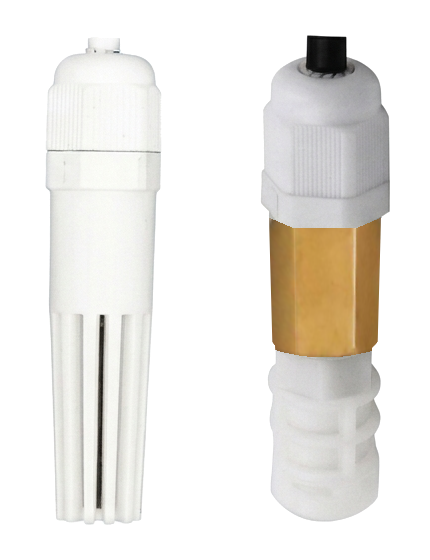
Air temperature and humidity transmitter with RS485 Modbus output. Two versions to choose from, PE or PVC.
The PE version has a metal collar and a ceramic filter, and is the one that best withstands condensation and cleaning. The PVC version is slotted plastic, lighter and more economical, for indoor spaces with no splashing. Both measure the same and speak the same.
The cable can be ordered with a connector, to plug in without tools, or with bare wires, to go straight into a terminal block. It speaks Modbus RTU with no gateway in between and is protected against reverse polarity: connecting it the wrong way round does not break it.
- Measures
- Temperature · Humidity
- Output
- Power supply
- 5 to 28 V DC
- Operating
- −20 to +60 °C
What sets it apart
Two formats for the same device
PE for damp environments and PVC for dry indoor ones. It is chosen by where it will live, not by what it measures.
With a connector or bare wires
A four-contact M10 connector with 50 cm of cable, or a stripped end to go into a terminal block.
One point of drift a year
Under 1 % RH and 0.1 °C of annual drift. What separates a process sensor from a desktop one is how far it wanders over time.
Modbus RTU communication
RS485 with Modbus RTU, no gateway and no proprietary protocol in between.
Configurations
| Material / housing | Cable length | Connector / output | Part number |
|---|---|---|---|
| PE head | 50 cm | M10 connector | SX-THG01-PE-50C-M10 |
| PE head | 50 cm | Pigtail | SX-THG01-PE-50C-PT |
| PVC head | 50 cm | M10 connector | SX-THG01-PVC-50C-M10 |
| PVC head | 50 cm | Pigtail | SX-THG01-PVC-50C-PT |
Specifications
General
- Measured parameters
- Temperature · Humidity
- Output
- RS485Modbus RTU, no gateway
- Medium
- Air
- Heads
- PEfor damp environmentsPVCfor dry indoor spacesotherOn request
Relative humidity
- Range
- 0 to 100 % RH
- Accuracy
- ±4 % RHFrom 5 to 95 % RH, at 25 °C. Two units measuring the same air can differ by that much: they are not guaranteed to agree any closer than their specification
- Resolution
- 0.1 % RH
- Stability
- ≤1 % RH/year
- Response time
- ≤8 sAt 1 m/s air speed. The equipment datasheet states ≤4 s; the less favourable of the two is published
Temperature
- Range
- −40 to +80 °C
- Accuracy
- ±0.5 °CAt 25 °C
- Resolution
- 0.1 °C
- Stability
- ≤0.1 °C/year
- Response time
- ≤25 sAt 1 m/s air speed. The equipment datasheet states ≤15 s; the less favourable of the two is published
Output and power
- Output interface
- RS485Modbus RTU protocol
- Power supply
- 5 to 28 V DC
- Maximum consumption
- 0.05 W
- Factory settings
- 4800 8N1, address 1
- Baud rates supported
- 2400 · 4800 · 9600 bpsThese three only
- Protection
- Reverse polarityConnecting it the wrong way round does not break it
- Measurement refresh
- 2 s
Cable and connection
- Termination
- M10 connector or bare wiresAccording to the part number ordered
- Cable length
- 50 cm
- Wires
- 4Brown and black the supply, green and blue the bus
Construction
- Electronics operating temperature
- −20 to +60 °CAt 0 to 80 % RH non-condensing. The other two equipment documents state −40 °C and up to 100 % RH; for each figure the less favourable one is published
- Head dimensions
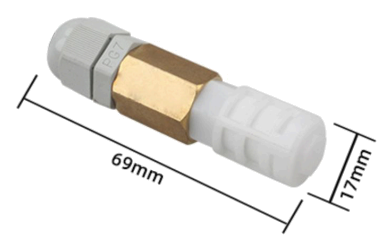
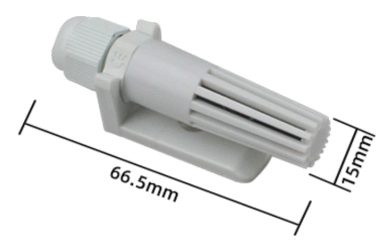
- 69 × 17 mmPE. Length by diameter66.5 × 15 mmPVC. Length by diameter
Manual
1Introduction
The THG01 measures air temperature and humidity and delivers them over RS485 in Modbus RTU. The transmitter is always the same; what is chosen when ordering is the head and how the cable ends.
This device must not be buried; it is to be used to measure air.
It measures from −40 to +80 °C and from 0 to 100 % relative humidity, with an accuracy of ±0.5 °C and ±4 % RH, and refreshes the reading every two seconds.
2How to order it
It is chosen in two steps: first the head and then how the cable ends.
| Head | Where it goes |
|---|---|
| PE | Metal collar and ceramic filter. It withstands condensation and cleaning: cold rooms, greenhouses, damp processes |
| PVC | Slotted plastic, lighter and more economical. Dry indoor spaces: offices, plant rooms, warehouses |
| Termination | What for |
|---|---|
| M10 connector | Four contacts, keyed. It plugs and unplugs without tools and without touching the terminal block |
| Bare wires | A stripped end, to go straight into a terminal block |
Both heads measure the same, with the same accuracy and the same register map. The electronics work from −20 to +60 °C in both cases. What changes, besides the material, is the size:
3Where to install it
The head measures the air around it, so wherever it is placed is exactly what will be read. Four things that change the reading more than any setting:
- •Away from heat sources and direct sun. A sunlit wall reads several degrees above the air in the room.
- •Clear of cold surfaces. If the head condenses, the humidity goes to the top of the scale and is slow to come down.
- •With the filter clear: no paint, no tape, no partition a centimetre away. The air has to get in.
- •At the height where the reading matters, not on the ceiling if what is being controlled is down below.
The PVC head has a mounting plate and screws to a wall or a bracket. The PE one does not: it is held by the cable gland or by the cable itself.
4Connection
The unit comes out with four wires. Two are the supply and two are the bus:
| Wire | What it is |
|---|---|
| Brown | Positive supply, 5 to 28 V DC |
| Black | Negative supply |
| Green | 485-A |
| Blue | 485-B |
On the version with a connector the four wires come already fitted into the M10, and it is simply plugged into a four-contact lead.
The supply is protected against reverse polarity: crossing the brown and the black does not break the unit. The bus wires have no such protection, in the sense that, crossed, the unit simply does not answer; if it answers nothing at all, the first thing to try is swapping the green and the blue.
With several units on the same bus a terminating resistor is needed at both ends.
5Reading the unit over RS485
Modbus RTU, from the factory at 4800 8N1 and at address 1. It takes 2400, 4800 and 9600.
Functions 03 and 04 return the same thing, so either will do. The measurement refreshes every two seconds; asking for it more often does not give a new figure.
For writing there are two more: 06 writes one register and 16 writes several in the same frame. Only the four read-and-write registers in the table below accept them; temperature and humidity are read only.
5.1What can be read
| Register | PLC | What it is | Scale | Access |
|---|---|---|---|---|
| 0x0000 | 40001 | Relative humidity | ÷ 10 | Read only · 03, 04 |
| 0x0001 | 40002 | Temperature, signed | ÷ 10 | Read only · 03, 04 |
| 0x0050 | 40081 | Temperature correction | ÷ 10 | Read and write · 03, 04, 06, 16 |
| 0x0051 | 40082 | Humidity correction | ÷ 10 | Read and write · 03, 04, 06, 16 |
| 0x07D0 | 42001 | Bus address | — | Read and write · 03, 04, 06, 16 |
| 0x07D1 | 42002 | Baud rate: 0 = 2400, 1 = 4800, 2 = 9600 | — | Read and write · 03, 04, 06, 16 |
Temperature comes in two’s complement: a value above 32767 is below zero. Both corrections leave the factory at zero and are added to the measurement.
5.2Frame examples
All the frames are for a unit at address 1 and already carry their CRC. There are only two shapes: function 03 to read and function 06 to write.
1 · Read the temperature and humidity
| Frame | Direction |
|---|---|
| 01 03 00 00 00 02 C4 0B | sent |
| 01 03 04 01 02 FF 33 5B EA | reply |
Two registers (00 02) are asked for from 0x0000. The unit returns four bytes (04): humidity first, 01 02, which is 258, that is 25.8 % RH; temperature after, FF 33, which is −205, that is −20.5 °C. Negatives come in two’s complement: a value above 32767 is below zero.
2 · Read the temperature correction
| Frame | Direction |
|---|---|
| 01 03 00 50 00 01 84 1B | sent |
| 01 03 02 FF F6 79 F2 | reply |
A single register (00 01), 0x0050. It answers two bytes (02): FF F6 is −10, that is a correction of −1.0 °C. From the factory that register is zero.
3 · Write the temperature correction
| Frame | Direction |
|---|---|
| 01 06 00 50 FF F6 48 6D | sent |
| the same frame | reply |
Function 06 writes one register: FF F6, which is −1.0 °C, goes into 0x0050. The unit answers by repeating the whole frame; if it comes back different, something has failed. The humidity correction is written the same way, changing 0x0050 for 0x0051.
4 · Change the address to 2
| Frame | Direction |
|---|---|
| 01 06 07 D0 00 02 08 86 | sent |
| the same frame | reply |
The address number goes in 0x07D0. We have not tried this one on the bench: the frame is the one the manufacturer documents.
5 · Set the baud rate to 4800
| Frame | Direction |
|---|---|
| 01 06 07 D1 00 01 19 47 | sent |
| the same frame | reply |
The baud-rate code goes in 0x07D1: 0 is 2400, 1 is 4800 and 2 is 9600. This one has not been tried on the bench either.
6 · Ask what address it is at
| Frame | Direction |
|---|---|
| FF 03 07 D0 00 01 91 59 | sent |
| 01 03 02 00 01 79 84 | reply |
The FF is a wildcard, for when the address of the unit is not known. The reply starts with 01, which is its own address, and the data 00 01 repeats it. We have not checked this on the bench; what is measured is that this unit does not answer at address 0.
7 · Read the baud rate
| Frame | Direction |
|---|---|
| 01 03 07 D1 00 01 D5 47 | sent |
| 01 03 02 00 01 79 84 | reply |
The reply is identical byte for byte to the one in the previous example and means something else: here the 00 01 is the baud-rate code, that is 4800 bit/s. What gives it meaning is the register that was asked for, not the reply.
Gallery
Documentation
Does it fit your case?
Tell us where the SX-THG01 is going and what you need to integrate it with. We’ll tell you whether it’s the right device — and if not, which one is.