
SIGNUX RPG01
The light the plant can actually use
Photosynthetically active radiation sensor for the 400 to 700 nm band, with an RS485 Modbus RTU or analogue output.
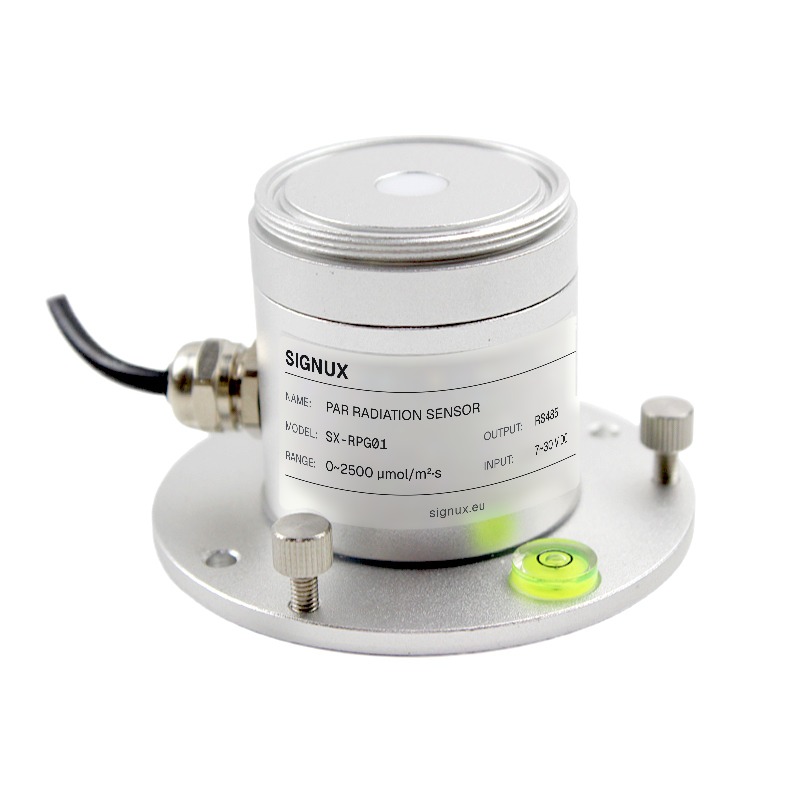
It works on the photoelectric principle: in light it produces a voltage signal proportional to the intensity of the incident radiation, and its sensitivity is proportional to the cosine of the angle of incidence. The cosine corrector keeps the standard cosine response.
The dust cover is treated so that dirt does not cling to it and so that environmental factors do not reach the components inside. It is used in meteorology, agriculture and air-pollution research.
- Measures
- PAR radiation
- Output
- 4-20 mAVoltage
- Protection
- IP67
- Operating
- −30 to +75 °C
What sets it apart
0 to 2500 µmol/m²·s
Resolution of 1 µmol/m²·s and accuracy of ±2 %.
Linearity ≤ ±1 %
And an annual stability of ≤ ±2 %.
7 to 30 V DC, 0.06 W
Wide-range supply and very low consumption.
Aluminium, IP67
Bubble level with adjustment handwheel, and −30 to +75 °C in service.
Configurations
| Cable length | Connector / output | Protocol / comms | Part number |
|---|---|---|---|
| 15 cm | Pigtail | RS485 | SX-RPG01-15C-PT-485 |
| 15 cm | M10 connector | RS485 | SX-RPG01-15C-M10-485 |
| 2 m | Pigtail | RS485 | SX-RPG01-2M-PT-485 |
| 2 m | M10 connector | RS485 | SX-RPG01-2M-M10-485 |
| 15 cm | Pigtail | 4-20 mA | SX-RPG01-15C-PT-420 |
| 15 cm | Pigtail | 0-5 V | SX-RPG01-15C-PT-05V |
| 15 cm | Pigtail | 0-10 V | SX-RPG01-15C-PT-010V |
Specifications
General
- Measured parameters
- PAR radiation
- Output
- RS485 · 4-20 mA · Voltage
- Spectral range
- 400-700 nm
- Measuring principle
- Photoelectric
Measurement
- Range
- 0-2500 µmol/m²·s
- Resolution
- 1 µmol/m²·s
- Accuracy
- ±2 %
- Linearity
- ≤±1 %
- Response time
- 10 µs
- Annual stability
- ≤±2 %
Output and power
- Output interface
- RS485 Modbus RTU / 4-20 mA / 0-5 V / 0-10 VDepending on the order code
- Power supply
- 7-30 V DC
- Consumption
- 0.06 W
Construction
- Ingress protection
- IP67
- Operating temperature
- −30 to +75 °C
- Housing
- All-aluminium
- Levelling
- Bubble level and adjustment handwheel
- Dimensions
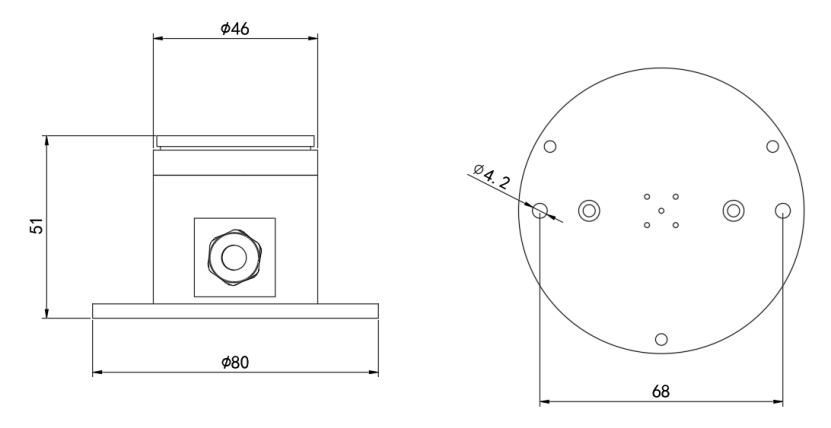
- ⌀80 × 51 mm80 mm base; 46 mm body diameter, from the dimensioned drawing
- Mounting
- Four ⌀4.2 mm holes on a 68 mm circle
- Cable length
- 15 cm or 2 m
Manual
1Introduction
The RPG01 measures photosynthetically active radiation, the 400 to 700 nm band. It works on the photoelectric principle: in light it produces a voltage signal proportional to the intensity of the incident radiation, and its sensitivity is proportional to the cosine of the angle of incidence.
The dust cover is specially treated to reduce dust adsorption and to keep environmental factors from interfering with the components inside.
- •Response spectral range from 400 to 700 nm.
- •All-aluminium housing, rated IP67.
- •Built-in bubble level and adjustment handwheel, to set it flat on site.
- •High-quality cosine corrector, which ensures the standard cosine response.
- •Wide-range supply, from 7 to 30 V DC.
It delivers the reading over a 4-20 mA, 0-5 V or 0-10 V analogue output, or over RS485 with the Modbus RTU protocol. It is used in meteorology, agriculture and air-pollution research.
2Installation
Before installing, check that everything is there: the unit with its black waterproof connector.
- •Pass the screws through the mounting holes on the sensor and fix it to the bracket.
- •Leave it parallel to the ground: turn the handwheel and watch the bubble in the level to check it.
- •Once it is installed, take off the protective cover.
3Connection
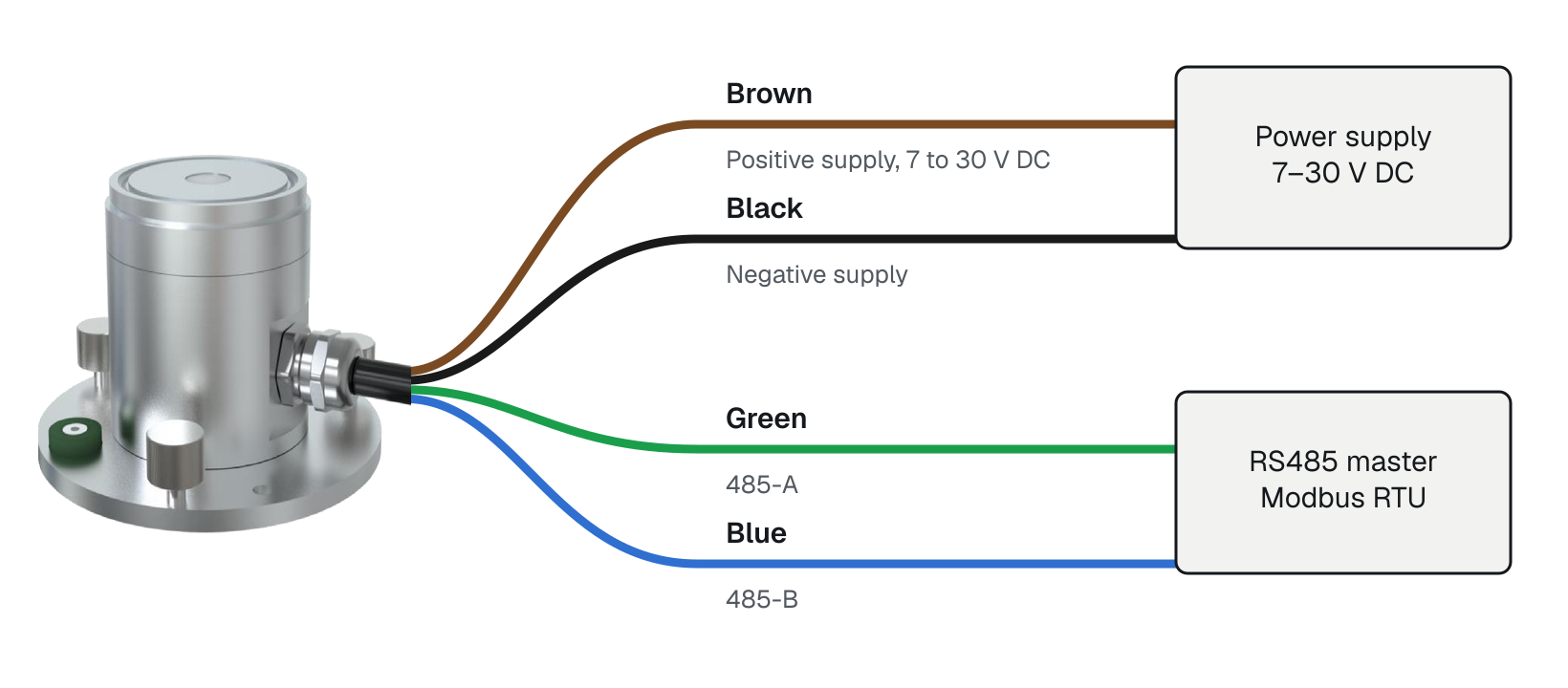
The unit comes out with four wires:
| Wire | What it is |
|---|---|
| Brown | Positive supply, 7 to 30 V DC |
| Black | Negative supply |
| Green | 485-A |
| Blue | 485-B |
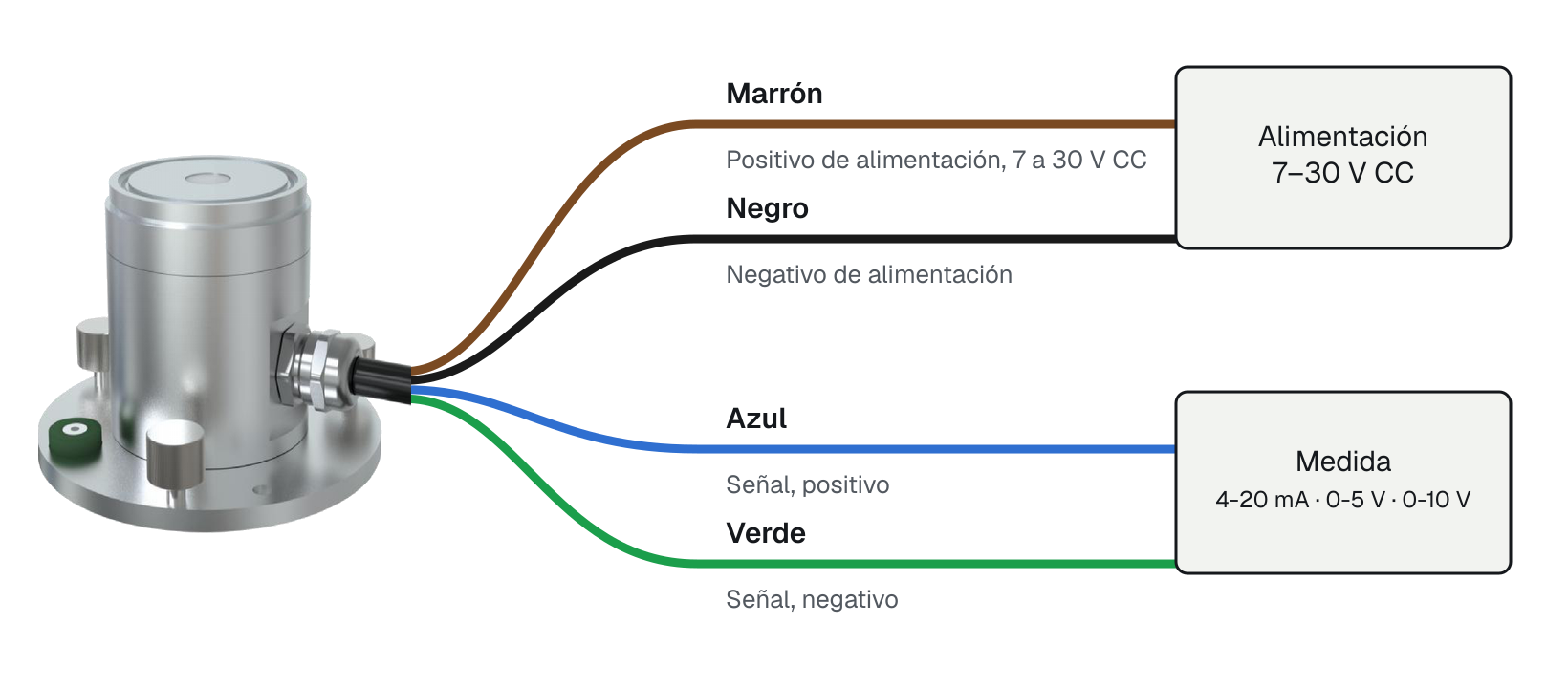
On the analogue version those same two wires are the signal: the blue one positive and the green one negative.
4Analogue outputs
The unit comes with one independent analogue output as standard and takes both three-wire and four-wire hook-ups. It runs on 7 to 30 V DC, except the 0-10 V output versions, which only work at 24 V.
In current, with the 0 to 2500 µmol range and a 4-20 mA output: the 2500 µmol are spread over the 16 useful mA, so each mA is 156.25 µmol. With 12 mA at the output, the reading is 12 − 4 = 8 mA, and 8 × 156.25 = 1250 µmol.
In voltage, with a 0-10 V output: the 2500 µmol are spread over the 10 V, so each volt is 250 µmol. With 4 V at the output, 4 × 250 = 1000 µmol.
5Reading it over RS485
Modbus RTU, with 8 data bits, no parity and one stop bit, and CRC. From the factory it runs at 4800 and at address 1. It takes 2400, 4800 and 9600.
For reading there is function 03 and for writing function 06. The 16-bit values go high byte first.
| Register | What it is | Access | Values |
|---|---|---|---|
| 0x0000 | PAR radiation | Read only | The actual value |
| 0x0052 | Deviation | Read and write | Signed, 16-bit |
| 0x07D0 | Address | Read and write | From 1 to 254; from the factory, 1 |
| 0x07D1 | Baud rate | Read and write | 0 = 2400, 1 = 4800, 2 = 9600 |
5.1Frame examples
All the frames are for a unit at address 1 and already carry their CRC.
1 · Read the value
| Frame | Direction |
|---|---|
| 01 03 00 00 00 01 84 0A | sent |
| 01 03 02 00 64 B9 AF | reply |
One register from 0x0000. The reply brings two data bytes: 00 64 is 100, that is 100 µmol/m²·s.
2 · Write the deviation
| Frame | Direction |
|---|---|
| 01 06 00 52 00 0A A8 1C | sent |
The deviation goes in 0x0052: 00 0A is 10, that is 10 µmol/m²·s. The reply is the same as the request.
3 · Change the address to 2
| Frame | Direction |
|---|---|
| 01 06 07 D0 00 02 08 86 | sent |
| 02 06 07 D0 00 02 08 B5 | reply |
The reply already comes from the new address.
4 · Set the baud rate to 9600
| Frame | Direction |
|---|---|
| 01 06 07 D1 00 02 59 46 | sent |
The baud-rate code goes in 0x07D1: 0 is 2400, 1 is 4800 and 2 is 9600. The reply is the same as the request.
5 · Ask for address and baud rate
| Frame | Direction |
|---|---|
| FF 03 07 D0 00 02 D1 58 | sent |
| 01 03 04 00 01 00 01 6A 33 | reply |
The question goes to address FF, which any unit answers. The reply says address 1 and baud rate 1, which is 4800.
6Faults and maintenance
If it does not read what it should, look in this order:
- •If it reads zero, check that there is light and that you have taken the protective cover off.
- •Check the 485 wiring and that it is not reversed.
- •The address may be wrong, or two units may share one; from the factory it is 1.
- •Check that the supply is the one on the label.
- •If none of the above, the unit is damaged.
Do not wire it with the power on: check the wiring first and power it up afterwards. It is a precision instrument, so do not take it apart.
Keep the surface clean and wipe it with a soft cloth now and then. Check from time to time that it is still level and that the screws have not worked loose.
Gallery
Documentation
Does it fit your case?
Tell us where the SX-RPG01 is going and what you need to integrate it with. We’ll tell you whether it’s the right device — and if not, which one is.